Novel Debut from alum Lauren Catron

June 12, 2013 by
Lauren Catron

Lauren Catron

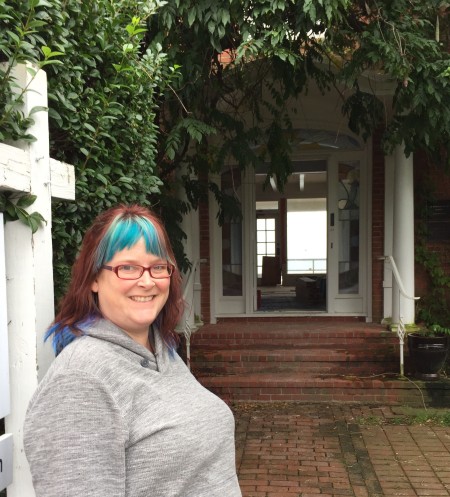
Wilkes alum Lauren Catron has been busy since graduating with her MA in Creative Writing. With the launch of her debut novel this summer, Catron has been putting her effort into finessing her website—and writing a sequel.

Changeling Eyes is the first book in the series. “In a way, The Aesir Chronicles are an alternate history of earth,” Catron says, “one that explains why we have legends of unicorns, fairies, Elves, trolls, dragons and many more. It is also a place if you will, where science, magic, and religion are all part of a whole rather than each excluding the other, as we always seem to think they must.”

The first book introduces Lrill and her struggle with her powerful heritage, and the revelation that there is a core of truth at the center of every legend. “I plan for the series to span from the creation of the world to its destruction and rebirth,” says Catron. “And since I’ve chosen to make this an alternate history of earth, I have every myth from every culture to play with—sort of like what Jim Butcher does in the Dresden Files. So you can anticipate cultural crossovers.”

Changeling Eyes is scheduled for a summer debut with Booktrope Publishing. Catron says she admires their publishing model that relies on a solid team to work toward the success of the book. The author, editor, proofreader, cover designer, and book manager all work together to ensure the best for the book. “This also gives the author a great deal of input into their cover design,” Catron says “The author can also commission work from a designer who does not work for Booktrope, and Booktrope will usually find a way to accommodate this choice.”

While Catron is focused on the pre-publication of Changeling Eyes, she is already at work on its sequel. “I also have a few Graphic Novel ideas,” sheCatron Final-Cover says, “though those are a couple years out in my plans. Most of my writing centers around The Aesir Chronicles and I find that whenever I dream up as a standalone novel idea, I can find an excuse to tie it back into the main series. Having the entire world’s pool of myth and legend to work out of it makes it easy to tie things together. I have some vampires and a little steampunk, and maybe ninjas.”

Readers will find more news about Changeling Eyes and updates about the series on Lauren Catron’s website, http://www.lacatron.com.

More help from Visiting Editor Veronica Windholz

June 5, 2013 by

Residency guest speaker Veronica Windholz has added to On Close Reading, her resource site for writers. The long-time editor first developed the website as a research archive for the workshop she developed and led at the Norman Mailer Colony, but she has since added information that all writers can access and apply to their creative toolboxes.

On Close Reading includes resources and guidance in the areas of composition, revision, and storytelling. The Editing Clinic includes lessons on Composition, Revision, and Storytelling.

In addition to editing resources, Windholz has added a selection of video clips from her most recent visit to the Wilkes University creative writing program. Graduating MAs will have the opportunity to interact with the editor at the upcoming summer residency.

In August 2013, Veronica Windholz will celebrate forty years of editing top-selling fiction and nonfiction for the major New York publishers.

New Program Tracks in Publishing and Film

May 29, 2013 by

Ever thought you wanted to start your own press, e-zine, or literary journal? Thanks to the initiative of Akashic Books editor Johnny Temple and Etruscan Press founding editor Phil Brady, alums and current students now have the option of pursuing a Master of Arts in Publishing! This new track will open at the June 2013 residency. Wilkes alums will take only an additional 18 credits to earn the M.A. in publishing.

Have you found the world of documentary film fascinating? The Wilkes low-residency program has also added a Master of Arts in documentary film, which will begin in January, 2014. Like the new publishing degree, alums need only take an additional 18 credits to earn this degree. The curriculum is being developed now working with Robert May and SenArt Films and other to be named companies.

For more information or to apply to any of the newly revised program tracks, please email or call Dr. Culver or Ms. Dawn Leas. Deadline to apply is May 31, 2013. Visit the Wilkes writing program website for updates.

Dr. Bonnie Culver, Director: bonnie.culver@wilkes.edu
Ms. Dawn Leas, Associate Program Director: dawn.leas@wilkes.edu
570.408.4527
570.408.4534

advisory board member Susan Cartsonis honored

May 22, 2013 by

Faculty and advisory board member Susan Cartsonis was recently honored for her accomplishments in film by the Crohn’s & Colitis Foundation of America at their 6th Annual Women of Distinction luncheon at the Beverly Hills Hotel.

Susan offered this speech at the luncheon:

Thank you so much for this honor. I’m excited to be sharing this day with Lisa Greer and Amy Brenneman. While I’ve been TOLD I’m being honored as a Woman of Distinction for my accomplishments in film, if we’re being really honest here, it’s about Stan. Stan Seidel was my life partner of seventeen years, and all around great guy, who died suddenly in 2000 and way too young at 48 of the complications Crohn’s Disease. Stan’s the real reason I’m being honored. And I’m more than ok with that.

Susan Cartsonis

Susan Cartsonis

I’m proud of the role I played in helping Stan prevail over his disease to become as he always said with truth behind the joke: a “well respected member of his chosen profession”. Which was screenwriting.

Stan used to call me, his “helpmeet”, which I thought was a word he just made up until I looked it up, Googled it last night, and found it is a combination of two roots from Hebrew, one meaning “to rescue” or “to save,” and the other meaning “to be strong.” The roots merged into one word, so did their meanings.

So I’d like to share this lovely award with all of the Women and Men of Distinction and helpmeets who have been and are caretakers for people with Crohn’s and Colitis and other debilitating diseases.

Those caretakers include people here like Miriam Scharf, who was Stan’s therapist. Miriam helped him break through creative barriers so that he got to see his work on the big screen, and got to be a well respected member of his chosen profession. Also, Dr. Ed Feldman, who reassured and comforted Stan about his condition from the moment Stan arrived in L.A. and encouraged him to go on adventures around the world, even when it presented a logistical nightmare due to shipments of medications, refrigeration, and risks. Under his care in the 90’s we went to London, Paris, Milan and Florence and the South Pacific—but not to Thailand or Mexico… (for those who weren’t there, there was a big laugh here—because it’s widely known that you have to be extremely careful about travel in these and certain other countries if you are vulnerable to these diseases.)

I share this also with friends like Kevin Goetz, whose late mother had M.S. and who takes care of others with M.S. now through a foundation he established in his mother’s name. And with friends with aging parents who are dealing with the challenges of giving and getting them help.

And I share the award with those of you who are caretakers I haven’t met or I don’t know about because you quietly, even secretly take care of someone in your life.

Secrecy is a big thing with bowel disease especially in the movie business. Not very glam. When Stan died it was a huge shock to people who knew us well. That’s because Stan didn’t want anyone to know anything about it. I respected Stan’s wishes not to discuss his disease publicly —which was hard. But I did it.

As a caretaker you gain a lot of wisdom and perspective along with the feeling that you too are sick without actually BEING sick. Caretaking taught me a lot about the nature of illness and life and death.

But once someone is gone, how do you continue to care for them? Well, in my case it’s by accepting this honor, and supporting important research about what ultimately killed Stan. That’s what he would have wanted. So thanks to you all for shedding light so that Crohn’s and Colitis can get the attention and funding it so deserves. I accept this award on behalf of all of the caretakers in the audience today and beyond. Thank you.

***

To learn more or to make a donation to the Crohn’s & Colitis Foundation of America, visit the CCFA website.

A Scribble of Writers: Q&A with Stephanie Riese

May 15, 2013 by
Stephanie Riese at the Jan '11 Wilkes residency

Stephanie Riese at the Jan ’11 Wilkes residency

Wilkes alum Stephanie Riese runs A Scribble of Writers, a blog and creative collective. In this Q&A, Riese talks about their group, book reviewing, and invites others to join the collaboration.

Stephanie, tell us about A Scribble of Writers. What compelled you to start a collective?

I actually came up with the idea for Scribble of Writers at Wilkes. My friends and I were sitting in a social media class, hearing about how important it is to get our names out there and have an online presence. Listening to the types of writing websites and blogs people were using, I thought, “Hey, why not start our own?” I bounced the idea off the girls and they were enthusiastic. I love editing and proofing, so founding the site sounded like a lot of fun to me!

As part of the blog, you provide creativity prompts. Do you then share the results with one another? 

The prompts are emailed out to everyone, and they email their pieces back to me. After any necessary edits, I post them to the website, where everyone has a chance to enjoy them.

Why do you include book reviews on the blog?

Book reviews were the suggestion of my friend Michelle, who wanted to write them. They’re a great way to get your name out there, and also generate great traffic for the website. I’d love to get a few more people to write them.

How can others get involved in A Scribble of Writers?

Anyone who would like to join the scribble need only send me an email and tell me what they’re interested in writing, be it the prompts, book reviews, etc. I’d like everyone to do the prompts in addition to anything else they enjoy, but I’m flexible. I’d love to see the site expand, with someone writing a blog about the writing process or other things like that.

***

Thanks, Stephanie. If you’re interested in contacting Stephanie Riese about A Scribble of Writers, you’ll find her on Facebook.

I Submit to You by Michael J. Soloway

May 8, 2013 by

I Submit to You

By Michael J. Soloway

The Rule of Twenty-Five

Sheepshead Review. Serving House. Newfound. Northwind. Palooka. Thin Air magazine (4x). fwriction review. Utter magazine. Superstition Review. TINGE Magazine. The Boiler Journal. Passages North. Thomas J. Hrushka Memorial Nonfiction Prize (3x). Prick of the Spindle. The Doctor T.J. Eckleburg Review. Hippocampus Magazine. Ploughshares—just to name a few.

lit magsIn all, I’ve received more than twenty-five rejections over the past thirteen months. They come in all shapes and sizes, with their own length and own voice. Like poems all titled, “Unfortunately…” Some offer compliments and encouragement; others simply cut you off at the knees and leave you feeling paralyzed with fear and insecurity. But a loss is a loss, whether it’s by thirty points or one.

Rejection is part of life, part of The Writing Life. But it’s also a word I associate with immaturity. After all, this isn’t one of those dreams where you’re late for a test without your No. 2 pencil; it isn’t high school. There is no prom to obsess over or folded notes to pass to potential dates—even though, at times, it may feel that way, as you ask yourself: Why not me? What’s wrong with me? I say: Nothing, especially if you haven’t even taken the plunge and submitted your work yet! And that doesn’t mean sending pages to your parents or friends or “one contest years ago.” Hilary Homzie, a children’s author at Hollins University, and a former mentor of mine, once told me: “You should always have twenty-five pieces of work in process at any one time.” Twenty-five? Yes, twenty-five. Five projects you’re writing; five you’re editing; five query letters you’re producing; five pieces you’re in the process of submitting; and five you’re waiting to hear back from an editor, agent, or publisher. Like sales, or any other business, it’s a numbers game—which simply means persistence is rewarded.

The Rebuff is Not Just For Cars

What’s the difference between a writer and an author? Have you ever turned this over in your mind? We call ourselves writers, but aren’t we already writers, all of us. Everyday, whether you’re writing or not, you are a writer; if you’re reading this then you most certainly are.

Perception and self-actualization is vital to growth and a continued formation of a positive identity. It’s time to start thinking of yourself as not only a writer, but an author as well. Whether you’ve published an essay or article or book or poem or blog or chapbook or a piece of haiku that began on a dinner napkin or if you haven’t published at all, give yourself permission to be an author. After all, we have Author pages on Facebook, not Writer pages. Be positive, then stay positive. Have your “Author’s Bio” ready. Know, deep down in your heart, that you’ll need it soon enough.

Along with my thirty aught rebuffs (a word I prefer over rejection, because it reminds me of polishing, that my work simply needs another run-through and that it’s not me that’s being rejected), I’ve also had successes this year as well—three essays and two memoir excerpts in seven different literary magazines over those same thirteen months. How have I done this? Quality work is only one ingredient to success. But courage and persistence is, by far, key to turning pages in an attic into pages into “print.” By rebuffing your work, and putting that first toe into what can sometimes be murky waters, you’ll be well on your way to becoming published—never immune to rejection, but an author ready to build upon success. After all, a translucent ocean does not reflect like the black sheen on the surface of a dark summer lake, it’s mystery reflecting your own image back at you, an identity that’s actually clear, if you stare long enough and catch the right amount of light.

Time is Relative (A Distant Cousin, Twice Removed) 

Excuses are never about time; they’re about energy.

clockTime, after all, is just a state of mind—we make time for what we want to make time for. “I can’t go to the gym, I don’t have time.” “I can’t cook dinner, I don’t have time.” “I can’t write a query letter, I don’t have time.” I have the same excuses: a full-time job, school, family, which includes a 21-month-old daughter. And I had the same self doubts you may have over your shoulder like a backpack—something to keep your work safe, but oh so heavy to lug around. I used to think one rejection meant my work was “no good.” Giving up is easy. But the only notion you should be giving up at this point is expectation.

A friend and peer, who many of you know from the Wilkes Creative Writing Program, Danielle Poupore’s, MFA (AKA, Danielle E. Curtis), essay, “Lilac Blossoms: A Dead Squirrel Story” was rebuffed fourteen times before being published in Split Lip magazine in March. Persistence, perseverance, and faith in your own words are your greatest tools. Use them to your advantage. Time is not the enemy. It’s simply a distant relative passing through town looking for a place to “crash” for the night. Learn to invite them in with open arms; embrace the time you do have, even if the only room you have left in your soul at the end of the day is a worn couch without pillows. There is pride and reward in effort.

It’s “Submittable” and More

Once you have a submittable story, set of stories, or script, depending on your genre, visit Poets & Writers website (www.pw.org). In the top navigation, find “Tools for Writers.” Underneath that you’ll see “Contests,” “Lit Mags,” and “Small Presses.” Once there, you can segment your search by Genre, Subgenre, Format, and Payment. And don’t get overwhelmed by your search results. There are 885 literary magazines that pop up without conducting an Advanced Search. But if I specify, “Creative Nonfiction” and “Autobiography/Memoir,” then my results are a much more manageable 133. Remember, this is a numbers game, but not a race. Concentrate on upcoming deadlines first, then make a commitment to submit a piece at least once a month. Follow the Rule of 25s, but unlike writing goals, submissions are not supposed to be part of a daily routine. I submitted my essays and excerpts sporadically over an entire year.

Most online magazines have made the transition to electronic submissions, which not only makes it easier to submit your work but also to track them through a system called “Submittable.” Once you make your first submission, and your account is set up, you can check the status of a piece any time of day. Be sure to read each publication’s submission guidelines carefully—word count limits, publication deadlines, and anything else that a specific journal prefers. There are still many “traditional” publications that will require a more detailed project description, query letter, or even a paper submission.

“Simultaneous Submissions” is your best friend. Find magazines that accept them and send, send, send. Just be sure to follow their instructions. If one of your pieces gets picked up, then notify the other magazines immediately so they can take your submission out of consideration—unless, of moneycourse, they permit reprints. I’ve had two essays “reprinted,” so look for those opportunities as well. And don’t forget about contests. Just be aware, most have submission fees. So, that option can get costly. On the flipside, contests offer monetary awards and oftentimes, major publication opportunities. Look for contests no more than $15 per entry. There are literally thousands, depending upon your genre.

Another word of advice—don’t expect payment, if your work is accepted. We all want to make a living at writing, but right now the focus should be on getting published, putting your name out there into the Universe, and forming a strong identity as an author. As of September, when my seventh piece is scheduled for publication, I will have earned exactly $45 from my yearlong submission/publishing efforts. So, if you’re looking for a mammoth payday, consider becoming an actuary or a nurse anesthetist.

Sticks and Stones

Rejection is not a 4-letter word, even though it may elicit a few when you get that response from an editor, agent, publication, or contest. Just remember, reject and accept have the same number of letters. The word you would rather hear is obvious, but one rejection does not an author make. They’re just sticks and stones. But the forest ahead doesn’t have to be so bleak. Turn any rebuff into feathers and leaves falling harmlessly at your feet and keep walking until you reach a clearing—every deep wood has one.

So, what am I really trying to say? Who do I think I am? Today, I hope I’m your drill sergeant, your platoon leader. I’m your inspiration, your mentor. I’m your best friend, your confidante. I’m that devil on your shoulder; I’m that saint.

Today, I’m an author. And so are you.

Being a writer is a complicated relationship. Don’t just look for The One. Find the many—you deserve to be an author for years to come.

So, what now you may ask? In the words of a wise mentor, teacher, writer, author, and friend, Kevin Oderman: “Onward.” I submit to you—there’s no place else to go.

***

Michael J. Soloway grew up eating oranges, catching lizards, and listening to the gasp of tennis ball cans being opened in south Florida. He received his Masters Degree in Creative Writing from Wilkes University and will earn his MFA in January 2014. In addition, Michael has served as Michael Solowaymanaging editor of more than a dozen nonprofit magazines and just finished his first memoir Share the Chameleon, about attempting to break his family’s cycle of abuse, as he becomes a father for the first time in his 40s. Brevity Magazine published Michael’s short essay, “Introducing Mother Nature,” in 2012. In addition, Split Lip magazine published his nonfiction essay, “Sticks and Stones,” about his grandmother’s slide into dementia, in March 2013. His work has also appeared in Red Fez, Serving House: A Journal of Literary Arts, and Under the Gum Tree magazines. An excerpt from Share the Chameleon will appear in Split Lip magazine in September 2013.

Introducing Northampton House Press

May 1, 2013 by

Northampton House Press LLC, a company founded in 2011, is buzzing with activity–and involvement from the Wilkes commuity.

EmpyresNew titles includes Blood & Honor by Wilkes alum Chelle Ang, Ordinary Angels by Joan La Blanc, The Mirror of Aberrantine from alum C. M. Mullane (Chad Mullen), and Empyres: Bloodblind by Wilkes alum John Koloski.

“It’s thrilling to see my book become a reality,” Koloski said. “I thought nothing could compare to seeing the e-book online, but then I held my first galley copy! That beautiful glossy paperback came with a note from Dave Poyer stating that there’s nothing like a new book in one’s hand. He was absolutely right!”

Koloski has also taken on the role of Science Fiction and Horror acquisitions editor, while Joan La Blanc acquires Romance, Wilkes faculty member Bob Arthur manages Poetry acquisitions, and David Poyer acquires all other genres.angels

The Wilkes connection to Northampton House Press doesn’t end there. Poyer said, “Works are in production from Neil Shepard, Rashidah Abu-Bakr, and Ken Vose, along with several books by graduated program members.” This semester, Wilkes student William Horn is interning with the publishing house.

“Northampton House publishes carefully selected fiction—historical, romance, thrillers, fantasy—and lifestyle nonfiction, memoir, and poetry,” Poyer said. “Its mission is to discover great new writers, especially those graduated from accredited MA/MFA programs who have not yet achieved commercial recognition, and give them a chance to springboard into fame.”

arthurThe publisher aims to bring something new to the marketplace and to readers, particularly the kind of works that may be overlooked by large trade houses. “Watch the Northampton House list at www.northampton-house.com,” Poyer said, “and Like us on Facebook to discover more innovative works of high quality from brilliant new writers.”

Fellowships Available: Norman Mailer Center

April 24, 2013 by
Fellowships_half_page

J. Michael Lennon offers a tour

Fellowship applications are now available for the 2013 season at The Norman Mailer Center. The Center and the Colony offers Fellowships for fiction, nonfiction and poetry writers during the second half of 2013. During a Fellowship period of three weeks, the mentoring faculty will be headed by three highly regarded writers. Greg Curtis will mentor Nonfiction, Meena Alexander, Poetry, and Jeffery Renard Allen the Fiction fellows, each of whom will be in residence.

This year, from July 20 to August 10, 2013, Michael Mailer will host the Center’s fellowship programs at Norman’s home in Brooklyn Heights, New York.  Wilkes faculty member J. Michael Lennon will again be leading workshops with NMC. The Workshop schedule and details are also available online: http://nmcenter.org/pages/view/13/workshops

Previously, Wilkes alum Patricia A. Florio attended the Provincetown sessions. She has this to say:

“We all were in awe of our surroundings as Norman Mailer’s energy filled the room. Dr. Lennon gave us a tour of the home early on Sunday morning. You have to experience this tour through his home to understand the magnanimous legacy that he left behind. His office and writing desk were exactly as he left it on the day he died.  Books surrounded him. Papers, drawings, ideas on index cards filled his desk. We were on the third floor of his home looking at the view of Provincetown. A view, we were told, that Norman Mailer loved….

Every morning as we entered the house, the view of the beach and Cape Cod Bay filled our eyes. Dr. Lennon’s voice filled our ears.  It was the perfect storm for creative juices to flow. And flow they did.”

For more information about The Norman Mailer Center and available programs, visit http://nmcenter.org.

Lennon’s Mailer Biography News

April 17, 2013 by

lennon-jacket-220Norman Mailer: A Double Life, by J. Michael Lennon, will be published by Simon and Schuster on October 15, 2013.

J. Michael Lennon, Norman Mailer’s archivist, editor and authorized biographer, teaches creative writing at Wilkes University, and is the founding president of the Norman Mailer Society.

Lennon has a new website where news about the book, related events and signings, and more is now shared online. Visit www.jmichaellennon.com. The site will be regularly updated, and you can sign in and comment on the displayed materials.

J. Michael Lennon

J. Michael Lennon

J. Michael Lennon was authorized by Mailer and the Mailer estate to write his biography, and as such, had access to family and friends, and to unpublished documents, notably Mailer’s letters (Lennon has edited the letters for publication by Random House, Mailer’s longtime publisher). He has interviewed more than 80 people for this biography, but most important of all, he knew Mailer for decades before the latter’s death in 2007.

Norman Mailer: A Double Life reflects Mailer’s dual identities: journalist and activist, devoted family man and notorious philanderer, intellectual and fighter, writer and public figure. Mailer himself said he had two sides “and the observer is paramount.” Readers of Lennon’s biography may find this self-assessment to be debatable.

Norman Mailer: A Double Life will be 800+ pages in length (around 330,000 words), contain a bibliography, 43,000 words of notes, an index, and about 55 photos which will tell the story of Mailer’s life in another way. It will sell for $37.50, but pre-ordered is $24.28, or $19.99 for an electronic version. You can also order it via the website.

Kait Burrier interviews Crystal Hoffman

April 10, 2013 by

Typewriters, Pilgrims, and Poetry:

An Interview with Crystal Hoffman

By Kait Burrier

Crystal Hoffman has led poetry workshops across the country, from public libraries to Burning Man Arts and Music Festival. She has taught at cover-sulfurwaterAmerican University of Beirut. Poems from her chapbook Sulfur Water (2012, Hyacinth Girl Press) have been translated into three languages. Hoffman studied creative writing at Carlow University and earned her M.A. from Indiana University of Pennsylvania. She is currently walking across the United States, gathering and scattering American myths via poetry.

Hoffman began her journey on March 25th, 2013, equipping herself with a tent, a change of clothes, an Olivetti 32 typewriter, and a modified cart affectionately named Connie. She left western Pennsylvania and is headed toward the Pacific northwest on what she anticipates will be a 6 month long journey spanning 2,550 miles on foot. She may be one of the few people who clicks the pedestrian icon while long-distance Google-mapping.

Crystal intends to revive the American myth and engage interested strangers in acts of poetry, much like she did as a founding member of the Typewriter Girls Cabaret. Along with poet Margaret Bashaar, Hoffman organized cabarets focused onparticipatory compositions. Many Typewriter Girls performances included various performing artists and writing games like Exquisite Corpse, and each event began with a typewriter at the door where, upon entering, audience members contributed a phrase to a collective poem.

In her Poetry Pilgrim Project, Crystal will engage in narrative therapy techniques with willing storytellers. Each poem will reflect that individual’s “hero’s journey” in the form of a poem. Crystal will type the poetry on card-stock, tie it with a ribbon, and present it to the individual, unearthing collective glorified narratives that will upturn a trail of American mythologyforged by poetry.

Kait BurrierPhoto: Jason Riedmiller

Kait Burrier
Photo: Jason Riedmiller

I recently had the opportunity to ask Crystal about her write life and about the Poetry Pilgrim Project:

Kait Burrier: You’re a poet, a performance artist, a teacher, an activist—how has all of this informed your writing?

Crystal Hoffman: When I write, I typically hear a voice speaking the words in my head. If I don’t or I’m concerned that something needs altered from how it came out originally, I will repeat it over and over out loud until it sounds right. This sometimes makes me look like a psycho in coffee shops—adds color to the place. I blame this need to hear on how central performance has been to my creative career.

As an activist, I attempt to resolve the paradoxes that frustrate me most in my work. I write poems that I wouldn’t call “issue” poems necessarily, but they attempt to work out why certain injustices and absurdities occur through narrative and images—not necessarily consciously, but they come up. The actual experience of protest I also find to be a poetic one, an energizing one, one wherein you can hear the magic of certain phrases.

There is also a beautiful absurdity to it. I used to be the one always itching for the game to be stepped up, looking for confrontation, hoping for a battle. It was in this space where I could see very clearly how I try to write the situations around me and get frustrated when I can’t manifest them. I have a lot of need for the control of my own story. I’m trying to get over this.

Crystal Hoffmanpoetrypilgrim.com

Crystal Hoffman
poetrypilgrim.com

In terms of being a teacher, I think that I’ve learned more about writing from teaching poetry at the American University of Beirut than I have in all of my schooling—preparing the classes, clarifying concepts for students, grading, re-evaluating my own standards, being forced to assess things I wouldn’t typically read. It was radical. It was possibly the most vital experience of my life.

KB: You are a founding member of the Typewriter Girls. Will you share about this experience?

CH: The Typewriter Girls were my central creative project for about five years. It was a beautiful thing. I was able to utilize the performances to serve as an outlet for nearly all of my creative urges: comedy, collaboration, theater, poetry, dancing, games, performance pieces, even writing the press releases became a pleasure—I wrote them like stories, absurd ones, and people responded to them!

However, this was also problematic, as it came to consume too much of my creative energy, which made me angry, as I became too attached… It was a rush, but a draining one. Margaret (Bashaar, of Hyacinth Girl Press) and I are actually planning on doing a reunion show, but we’re not going to be doing them regularly as we were before. I would love to start writing sketch comedy again and writing scripts for performance art pieces, but I think I’d like to do it as a part of festivals or in someone’s already established troupe.

I see this walk as almost the opposite of the Typewriter Girls, despite the fact that the interview-poem process I will be writing along the way was developed through them.

KB: You have been active in multiple cities across the country in alternative poetry readings. You have taught both locally and abroad. Now you will travel across the country on your own with a typewriter. What do you hope to find? What do you hope to share? Do you have any plans or will you take a day-to-day approach?

CH: I’m definitely taking the day-to-day approach. I know that I’m going to be taking the Great American Discovery Trail at first through West Virginia and to Cincinnati. At that point, I’m going to see what feels right. Hopefully, I can head north from there and get to Montana by July. The only big thing that I want to make is the Rainbow Gathering, but it’s not a huge deal if I don’t. I’m going to try to set up last minute readings/writing sessions as I get a better idea of my timeline, but for now, it’s nebulous. Anything can happen. I like that.

www.poetrypilgrim.com

poetrypilgrim.com

***

If you’re feeling generous, you can donate to Crystal Hoffman’s Kickstarter here: http://www.poetrypilgrim.com/ 

If you’re still feeling generous and want to give her a pair of new walking shoes in exchange for a poem, or if you just want to see what she is up to, you can see Poetry Pilgrim Project updates here: http://www.poetrypilgrim.com/

Kait Burrier is an MFA candidate in the Wilkes Creative Writing Program. She and photographer Jason Riedmiller travel near, far, and further to bring NEPA the latest in live music. Pick up a copy of the Weekender or check www.theweekender.com for updates.


Follow

Get every new post delivered to your Inbox.

Join 27 other followers